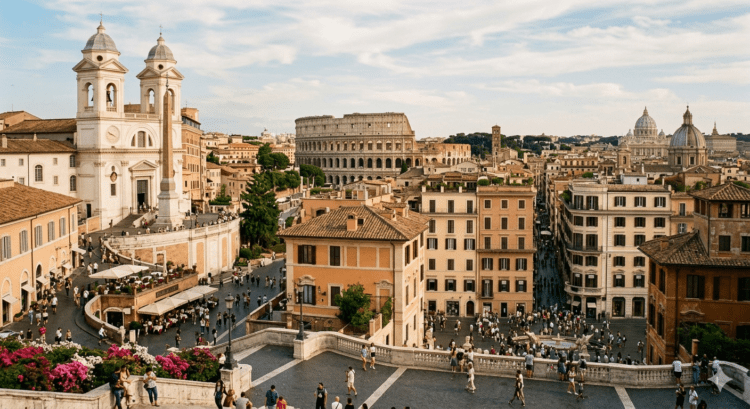
Rome, the “Eternal City,” is a living museum where 3,000 years of history, art, and culture blend seamlessly with a vibrant modern lifestyle. Whether you are a history buff, an art lover, or a foodie, Rome offers an experience like no other city on Earth.
Why Visit Rome?
- A Journey Through Time: It is one of the few places where you can see a 2,000-year-old temple, a Renaissance palace, and a modern boutique all on the same street.
- World-Class Art: From Michelangelo’s frescoes to Bernini’s sculptures, Rome holds a massive portion of the world’s artistic heritage.
- Culinary Excellence: The food alone—authentic Carbonara, crispy pizza, and artisanal gelato—is worth the flight.
- The Atmosphere: It’s about “La Dolce Vita” (The Sweet Life)—sipping espresso in a piazza and soaking in the sun.
Top 10 Places to Visit in Rome
1. The Colosseum
- Why: The ultimate symbol of Roman power. It is the largest ancient amphitheater ever built and a wonder of the world.
- Guide Tip: Don’t just look from the outside. Book a tour that includes the Underground Chambers to see where gladiators prepared for battle.
2. Vatican City (St. Peter’s Basilica & Vatican Museums)
- Why: The spiritual heart of the Catholic Church and home to the Sistine Chapel. The scale of the art and architecture is breathtaking.
- Guide Tip: There is a strict dress code (shoulders and knees covered). Book “Skip-the-Line” tickets via Viator at least 4 weeks in advance to avoid 3-hour queues.
3. The Pantheon
- Why: The best-preserved building from Ancient Rome. Its concrete dome, with the “Oculus” (eye) in the center, has baffled architects for 2,000 years.
- Guide Tip: Entrance now requires a small fee. Visit at noon when the sunlight streams through the dome in a perfect beam.
4. Trevi Fountain
- Why: The most beautiful Baroque fountain in the world. Legend says if you throw a coin over your left shoulder, you are guaranteed to return to Rome.
- Guide Tip: To avoid massive crowds, visit at sunrise or after midnight. It is beautifully illuminated at night.
5. Roman Forum & Palatine Hill
- Why: This was the “Downtown” of Ancient Rome. Walking here feels like walking through history among temples, markets, and government buildings.
- Guide Tip: This involves a lot of walking on uneven stones. Wear comfortable sneakers!
6. Spanish Steps
- Why: A grand 135-step staircase that is a masterpiece of Italian design. It’s the perfect spot for people-watching near the luxury shopping district.
- Guide Tip: It is technically illegal to sit and eat on the steps now to preserve the monument, so keep moving and take your photos!
7. Piazza Navona
- Why: Rome’s most elegant square, built on the site of an ancient stadium. It features Bernini’s famous “Fountain of the Four Rivers.”
- Guide Tip: This is a great spot for street artists and cafes, but avoid eating dinner directly in the square as prices are very high for tourists.
8. Castel Sant’Angelo
- Why: Originally built as a mausoleum for Emperor Hadrian, it later became a fortress and a papal residence connected to the Vatican by a secret tunnel.
- Guide Tip: Go to the rooftop terrace for one of the most incredible panoramic views of the city and St. Peter’s Basilica.
9. Trastevere Neighborhood
- Why: The “real” Rome. With its narrow cobblestone alleys and ivy-covered buildings, it is the best place for authentic nightlife and food.
- Guide Tip: Come here in the evening for dinner. It’s much more lively and has the best “Cacio e Pepe” pasta in the city.
10. Borghese Gallery & Gardens
- Why: A stunning villa housing some of the world’s most important sculptures by Bernini and paintings by Caravaggio.
- Guide Tip: Tickets are extremely limited and must be booked weeks in advance. The surrounding park is perfect for a relaxing bike ride.
Essential Practical Information
- Best Time to Visit: April to May (Spring) or September to October (Autumn) for perfect weather.
- How to Get Around: Most of the historic center is best explored on foot. For longer distances, use the Metro (Lines A & B).
- Water is Free: Carry a reusable bottle. You can refill it for free at any of the “Nasoni” (public fountains) found all over the city.
- Avoid Tourist Traps: Never eat at a restaurant that has pictures of food on a board outside or someone standing at the door calling you in.
Make Your Trip Hassle-Free!
Rome is beautiful, but the long lines at the Colosseum and Vatican can ruin your day.
[Click here to browse and book the best Rome tours via Viator] with Skip-the-Line access and Free Cancellation. Don’t waste your holiday standing in line—book your experience today!
Why You Should Book Your Rome Trip Through Viator? Read Full Guide
Suggested 3-Day Itinerary
- Day 1: Ancient Rome. Colosseum, Roman Forum, and Palatine Hill.
- Day 2: The Heart of Rome. Pantheon, Trevi Fountain, Piazza Navona, and Spanish Steps.
- Day 3: The Vatican & Trastevere. Vatican Museums in the morning, and dinner in Trastevere to end your trip.
Q1: How many days are enough for a trip to Rome?
Ans: To see the major highlights like the Colosseum, Vatican, and the historic center, 3 to 4 days are ideal. If you want to explore hidden gems or take a day trip to Pompeii, 5 days would be perfect.
Q2: Is it necessary to book tickets in advance for Rome attractions?
Ans: Yes, absolutely. For the Colosseum and Vatican Museums, tickets often sell out weeks in advance. Using Viator to secure “Skip-the-Line” tickets is highly recommended to avoid waiting 2–3 hours in the sun.
Q3: Can I drink water from the public fountains in Rome?
Ans: Yes! Rome has over 2,500 small fountains called “Nasoni.” The water is cold, clean, and free to drink. Carrying a reusable bottle will save you a lot of money.
Q4: What is the best way to get from the Airport to the City Center?
Ans: The Leonardo Express train is the fastest way, taking only 32 minutes from Fiumicino Airport to Termini Station. For a more budget-friendly option, several shuttle buses are available.
Q5: Is Rome safe for tourists?
Ans: Rome is generally a very safe city. However, like any major tourist destination, you should be careful of pickpockets, especially in crowded areas like the Metro, the Colosseum, and near the Trevi Fountain.
Q6: Do I need to tip at restaurants in Rome?
Ans: Tipping is not mandatory in Italy. Often, a small “Coperto” (cover charge) is already added to your bill. However, leaving 1–2 Euros or rounding up the bill is appreciated if the service was excellent.
Q7: What is the dress code for visiting churches?
Ans: To enter churches like St. Peter’s Basilica or the Pantheon, you must follow a strict dress code: shoulders and knees must be covered. Carrying a light scarf in your bag is a good idea to cover up when needed.

Leave Comment