Every passionate traveler knows the exact moment the vacation planning high starts to fizzle out. You have spent hours hunting down the perfect flight combination. You have compared dozens of hotel rooms to find the one with the best view and proximity to transit.
But then, you look at your itinerary. It is a completely blank canvas.
You ask yourself: “What am I actually going to do when my feet hit the ground?”
Do you want to stand in a three-hour ticket line under a blistering Roman sun just to catch a glimpse of the Colosseum floor? Do you risk your safety by booking a spontaneous scuba diving excursion with an unvetted street vendor in Bali? Do you spend your precious evening hours in Paris endlessly scrolling through localized blogs trying to figure out which wine-tasting experience is authentic and which one is a tourist trap?
This is where Viator comes into play.
As the world’s largest online marketplace for travel activities, tours, attraction tickets, and destination experiences, Viator has fundamentally transformed how humanity experiences global travel. However, navigating a platform that hosts hundreds of thousands of distinct offerings across thousands of destinations requires strategy.
Whether you are a first-time vacationer looking to book a simple airport shuttle, a seasoned globe-trotter looking for an exclusive, off-the-beaten-path culinary masterclass, or a content creator analyzing how this giant operates, this comprehensive, 2,500+ word master guide will dissect everything you need to know about Viator.
1. What is Viator? Decoding the World’s Largest Travel Experience Marketplace
To truly understand how to use Viator to your advantage, you must first understand exactly what it is—and, perhaps more importantly, what it is not.
The Core Concept: A Multi-Sided Marketplace
At its absolute core, Viator is an online aggregator and third-party marketplace. It is the experiential equivalent of what Expedia is to flights, Airbnb is to lodging, or Uber is to urban transportation.
Viator does not own tour buses. They do not employ local historical guides. They do not manage zipline parks, cooking schools, or boat charters. Instead, Viator provides a highly sophisticated, secure, and centralized digital infrastructure that connects two distinct groups of people:
- The Travelers: Individuals looking to discover, organize, and securely book activities anywhere in the world.
- The Local Tour Operators: Independent local businesses, independent guides, boutique agencies, and large-scale attraction companies that want to showcase their services to a global audience.
The Power of the Corporate Ecosystem
Founded in 1995 in Australia, Viator was a true pioneer in the digital travel space. Recognizing its immense potential to dominate the “things to do” sector, the travel giant Tripadvisor acquired Viator in 2014 for approximately $200 million.
This acquisition created a massive travel ecosystem. Today, when you search for a destination on Tripadvisor and see a button that says “Book a Tour,” that button is almost always powered directly by Viator’s massive inventory. By leveraging Tripadvisor’s unmatched database of user-generated content and reviews alongside Viator’s robust transactional booking engine, the platform has scaled to offer more than 300,000 bookable experiences across more than 200 countries.
The Complete Inventory Spectrum
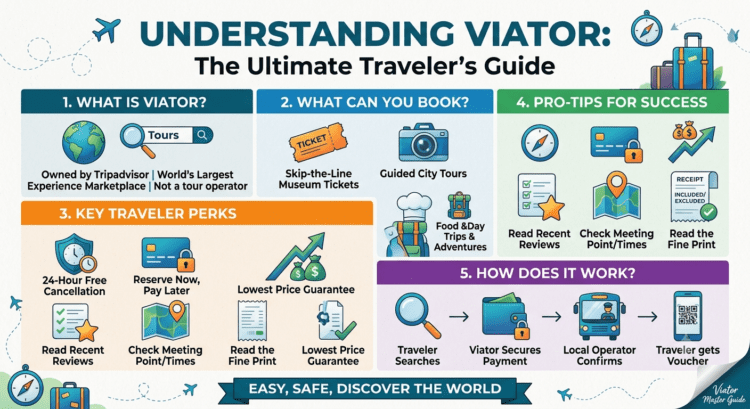
What can you actually buy on Viator? The diversity of the inventory is staggering, generally falling into five primary buckets:
- Skip-the-Line & Monument Access: Direct digital entry vouchers to the world’s most iconic landmarks (e.g., The Vatican Museums, the Eiffel Tower, the Empire State Building, or the Taj Mahal). These often bypass the primary ticket-purchase queues, saving travelers literal hours of standing in line.
- Guided Day Trips & Excursions: Full-day or multi-day guided trips that handle all transit logistics out of a major hub city. Examples include a day trip from Munich to Neuschwanstein Castle, or a journey from Marrakech into the Agafay Desert.
- Immersive Cultural & Culinary Experiences: Highly localized activities like private market walks with a chef in Tokyo, street-food tasting tours in Mexico City, or traditional pottery workshops in Kyoto.
- Adventure, Nature, & Outdoor Activities: High-adrenaline or outdoor pursuits including whale watching in Iceland, helicopter flights over the Grand Canyon, or ATV tours through the jungles of Costa Rica.
- Logistical Utilities: Often overlooked but incredibly practical services like private airport transfers, hop-on-hop-off bus passes, pocket Wi-Fi rentals, and professional vacation photography packages.
2. Behind the Scenes: How Does the Viator Ecosystem Actually Function?
For a user, booking an activity feels as simple as a few clicks on a smartphone. But behind that clean user interface is a complex mechanism designed to protect transactional security, manage real-time global scheduling, and maintain quality assurance across vastly different time zones and cultures.
The Mechanics of the Third-Party Relationship
When you find an activity you love on Viator—say, a “Small-Group Sunset Sailing Cruise in Santorini”—and hit the purchase button, a synchronized chain reaction occurs:
[Traveler Books on Viator]
        │
        ▼
[Viator Holds Payment Securely & Notifies Local Operator]
        │
        ▼
[Local Operator Confirms Inventory & Provides the Experience]
        │
        ▼
[Viator Releases Funds to Operator (Minus Platform Commission)]
This setup benefits both parties. The local operator doesn’t have to build an expensive website or figure out how to process international credit cards. Meanwhile, you, the traveler, get the peace of mind that comes with dealing with a major global corporation rather than sending your credit card details to an unknown email address across the world.
The Real-Time Inventory Engine
One of the greatest technical challenges Viator successfully conquered is real-time inventory management. If a local cooking instructor in Florence only has 8 spots available in their kitchen for Tuesday night, the platform must ensure they don’t sell 12 spots.
Viator integrates directly with the booking software used by local operators (API integrations with systems like FareHarbor, Rezdy, and Peek). This ensures that when a spot is sold on Viator, it instantly updates across all platforms, preventing the headache of overbooking.
3. The Definitive Checklist: Weighing the Pros and Cons of Viator
To write an authoritative article or make an informed consumer decision, one must look objectively at both sides of the coin. Viator offers undeniable structural benefits, but it also features inherent limitations that every user must understand.
The Structural Advantages (Why It Is Highly Recommended)
1. The “Reserve Now, Pay Later” Paradigm Shift
Historically, booking travel activities months in advance meant tying up thousands of dollars of disposable income long before your vacation ever began. Viator completely disrupted this dynamic by introducing its Reserve Now, Pay Later feature.
When you find a high-demand, limited-capacity tour (such as an exclusive early-morning tour of the Sistine Chapel), you can lock in your exact date and time slot immediately. Viator will secure your booking for a nominal $0 to $1 temporary authorization charge, and your credit card will not be fully charged until roughly 2 to 3 days prior to the actual activity date. This allows you to plan your itinerary with total financial freedom.
2. Universal 24-Hour Free Cancellation Policy
Nothing introduces chaos into life quite like a vacation itinerary. Flights get delayed, children get sick, weather patterns shift, or you might simply wake up one morning feeling too exhausted to embark on a 10-hour walking tour.
Viator accommodates this reality by enforcing a standardized 24-hour free cancellation policy on the vast majority of its listings. As long as you log into your dashboard and click “Cancel” at least 24 hours before the scheduled local start time of your tour, Viator will automatically process a 100% full refund directly back to your original payment method, no questions asked, and no customer service friction required.
3. Deep Centralization of Travel Logistics
Imagine booking seven different excursions across three European cities through seven independent local websites. You would end up with seven different email confirmations, varying customer account logins, disjointed cancellation windows, and an absolute mess of digital receipts.
Viator centralizes everything. The Viator mobile app acts as a digital wallet for your entire vacation. Every ticket, every meeting point map, every operator contact number, and every receipt lives under one single login, accessible completely offline when you are traveling abroad without cellular data.
4. The Lowest Price Guarantee Safety Net
A common fear among travelers is that using a major third-party aggregator like Viator means paying an inflated “middleman tax.” To alleviate this concern, Viator offers a robust Lowest Price Guarantee.
If you book an experience on Viator and subsequently find the exact same tour, offered by the exact same local operator for the same date and language, listed online for a lower price within three days of your booking, you can submit a claim. Viator will verify the listing and promptly refund you the entire price difference.
The Inherent Disadvantages (The Common Pitfalls to Watch For)
1. The “Middleman” Communication Disconnect
Because Viator sits between you and the actual tour guide, a layer of communication insulation is introduced. If a tour operator needs to change the meeting location at the last minute due to a sudden road closure, they must push that update through Viator’s system to reach you. If you don’t check the app or your email while traveling, you might miss it.
Similarly, if you are running 5 minutes late and trying to reach your guide, calling Viator’s corporate customer service line will not help you catch the tour bus; you have to contact the local operator directly using the local phone number hidden on your voucher.
2. Risk of Inflated Pricing vs. Direct Booking
While the Lowest Price Guarantee protects you if you find a lower price online, it does not always cover localized, offline realities. In many developing nations or highly competitive beach destinations, booking a tour directly at a local kiosk on the street corner or at your hotel front desk can be significantly cheaper than the online listed price on Viator, as street vendors often adjust prices dynamically based on cash negotiation.
3. Varying Quality Across Operators
Viator is an open marketplace. While they vet companies for basic legality, insurance, and licensing, they do not micromanage the daily execution of the tours. One listing could be a premium, masterfully narrated luxury tour, while another listing right next to it could be an overcrowded, uninspired bus ride. The burden of filtering the quality falls entirely on the consumer.
4. Masterclass: How to Read Viator Reviews Like a Travel Industry Pro
Because anyone can list a tour on Viator provided they meet basic criteria, the platform’s review section is its most important feature. However, looking blindly at the overall star rating is a rookie mistake. To ensure your vacation is flawless, you must learn how to analyze reviews like an industry insider.
The Flaw of the Aggregate Star Rating
A tour with a 4.8-star rating out of 2,500 reviews looks like an absolute home run. But what if that tour recently changed its head guide, or was bought out by a cheaper management firm three months ago? Those historical 5-star reviews from 2021 are completely irrelevant to the experience you will have today.
Step-by-Step Review Audit Strategy
When evaluating an experience you want to book, execute this three-step audit process:
- Step 1: Filter Explicitly by “Most Recent”: Always ignore the default “Most Relevant” sorting algorithm. Force the interface to show you what travelers experienced last week, last month, or during the current travel season. This exposes immediate, real-time issues like broken tour bus air conditioning, deteriorating food quality, or construction closures at key stops.
- Step 2: Scrutinize the 2-Star and 3-Star Sweet Spot: 5-star reviews are often written in a state of post-vacation euphoria, while 1-star reviews are frequently irrational rants written by people who were angry about something outside the operator’s control (e.g., “It rained during our boat tour! 1 star!”). The absolute truth about a tour almost always lives in the 2-star and 3-star reviews. These travelers are rational; they will tell you exactly what went right, followed by the specific details of what went wrong (e.g., “The guide was brilliant, but the lunch provided was tiny and we spent 45 minutes waiting inside a souvenir shop we didn’t want to visit.”).
- Step 3: Hunt for the “Time Share / Souvenir Shop” Trap: Many low-cost day trips are subsidised by local factories, rug shops, leather tanners, or souvenir outlets. Read the text of the reviews carefully to see if past travelers complain about being forced to spend an hour of their day sitting through high-pressure sales pitches disguised as “cultural demonstrations.”
5. Viator vs. The Competition: A Detailed Head-to-Head Comparison
While Viator commands massive global market share, it is not the only player in the digital experiences arena. Depending on where you are traveling, its competitors might offer a superior alternative.
| Feature / Platform | Viator | GetYourGuide | Klook | Airbnb Experiences |
| Primary Geographic Strength | Global (Unbeatable in North America & Caribbean) | Western & Central Europe | Asia-Pacific (APAC Region) | Hyper-Local (Major Global Urban Centers) |
| Total Inventory Volume | Over 300,000+ listings | Over 60,000+ listings | Over 100,000+ listings | Highly curated, smaller inventory |
| Core Vibe & Style | Traditional tours, large attractions, logistical transfers | Modern, highly curated, youth-skewed, crisp branding | Theme parks, transit passes, rail tickets, regional attractions | Deeply intimate, hobbyist-led, non-commercial activities |
| Cancellation Architecture | Standardized 24-hour free window across almost all listings | Highly standardized 24-hour free window | Highly variable (often strict, non-refundable tickets) | Variable based on host tier (often strict 3-7 day rules) |
GetYourGuide: The European Challenger
Based out of Berlin, GetYourGuide is Viator’s most formidable rival. While its overall inventory is smaller, GetYourGuide focuses heavily on a clean aesthetic, a premium mobile application user experience, and deeply curated partnerships. If you are traveling through Germany, France, Italy, or the UK, you will often find that GetYourGuide has cleaner, more modern listings, and even runs its own beautifully branded gray-and-red premium tours.
Klook: The King of Asia
If your travels are taking you to Tokyo, Bangkok, Singapore, Seoul, or Hong Kong, checking Viator alone is a massive mistake. Klook is the undisputed powerhouse of the Asia-Pacific travel sector. Klook excels at securing massive, direct corporate partnerships with major Asian attractions (like Tokyo DisneyResort, Universal Studios Japan, or the high-speed Shinkansen rail systems). Klook’s pricing in Asia is almost always lower than Viator’s, and their mobile voucher integration with Asian transit systems is vastly superior.
Airbnb Experiences: The Boutique Alternative
While Viator excels at getting you into the Colosseum or onto a massive catamaran cruise, Airbnb Experiences focuses on human-to-human connection. These are activities hosted by everyday locals inside their own homes, studios, or neighborhoods. You won’t find airport shuttles or hop-on-hop-off buses here; instead, you’ll find niche activities like “Learn Astrology from a Psychic in New Orleans” or “Forge a Samurai Sword with a Master Blacksmith in Kyoto.”
6. Avoiding the Trap: Red Flags and Fine Print to Check Before You Click “Book”
To ensure a seamless experience on Viator, you need to understand how to read between the lines of a listing. Tour operators are masters of marketing copy; here is how to uncover the hidden realities of a tour before authorizing payment.
The Illusion of the “Small Group Tour”
When you see the phrase “Small Group Tour” in a Viator title, what number pops into your head? Most people imagine 6 to 10 individuals walking together. However, in travel industry marketing terms, “small group” is completely relative.
Always scroll down to the “Additional Info” section of the Viator page and look for the specific line item that dictates the maximum capacity. You will frequently discover that an operator’s definition of a “small group” is up to 24 or even 30 participants. If you want a truly intimate experience, actively look for listings that explicitly guarantee a maximum cap of 8 to 12 people.
The Hidden “Exclusions” Tax
Nothing sours an excursion faster than arriving at the meeting point only to discover you need to pull out your wallet and pay more money. Carefully examine the Inclusions and Exclusions tab. Common hidden costs include:
- National Park Fees / Eco Taxes: Common on boat trips, snorkeling tours, and volcano hikes. The Viator ticket covers the boat ride, but you must pay $10-$20 USD cash at the pier for entry to the marine preserve.
- Monument Admission Fees: A tour might be titled “Guided Walk of the Alhambra,” but the fine print reveals the price only covers the guide’s time, and you are required to purchase your own monument entry ticket separately.
- Fuel Surcharges: Frequently tacked onto helicopter rides, private boat charters, or long-distance 4×4 safaris due to shifting global oil prices.
7. The Step-by-Step Strategic Booking Workflow
To bring all this knowledge together, here is the exact step-by-step framework you should follow every single time you use Viator to construct a travel itinerary.
Phase 1: The Preliminary Discovery Research
Do not begin your research on Viator itself. Begin on standard travel blogs, YouTube, and map tools to understand the geography of your destination. Determine the 3 to 4 major landmarks or experiences that are absolute non-negotiables for your trip.
Phase 2: The Viator Filter Strategy
Log into Viator, input your destination, and apply the following search filters immediately:
- Set the sorting mechanism to “Traveler Rating” or “Featured.”
- Filter by your specific date range to eliminate unavailable options.
- If you have a strict schedule, filter by duration (e.g., “Half-day” vs. “Full-day”).
Phase 3: The Cross-Reference and Validation Process
Once you find a highly-rated listing that matches your budget and timeline, do not book it immediately.
- Identify the Operator: Look at the top right or bottom of the listing where it says “Tour Operated By: [Local Company Name]”.
- Google the Operator: Open a new browser tab and search for that specific local company name on Google Maps or Tripadvisor. Read their direct business profile reviews.
- Compare Direct Pricing: Check the local company’s direct website. If the direct website is significantly cheaper and offers the same cancellation policy, consider booking directly to ensure 100% of your money goes to the local business. If the prices are identical, book on Viator to take advantage of the centralized app management and the flexible “Reserve Now, Pay Later” payment architecture.
Phase 4: Day-of-Tour Execution Blueprint
- Screenshot Everything: Do not rely on international cellular networks or spotty public Wi-Fi at a train station. Open the Viator app while connected to your hotel Wi-Fi, open your voucher, and take clear screenshots of the QR code, the meeting point address, and the operator’s direct phone number.
- Arrive 20 Minutes Early: Travel groups wait for no one. If a day-trip bus is scheduled to depart at 8:00 AM, they will typically begin boarding at 7:45 AM and pull away precisely at 8:00 AM. Being late by two minutes means forfeiting your ticket without a refund.
- Bring Cash for Tipping: While your tour is fully paid for via Viator, tipping your guide is standard practice across much of the globe (especially in North America, Egypt, parts of Europe, and Southeast Asia). Keep small denominations of local currency accessible.
8. For Content Creators: Monetizing Travel Through the Viator Affiliate Program
If you are reading this guide not just as a traveler, but as a blogger, digital nomad, or travel content creator, Viator represents an exceptionally lucrative monetization pathway.
Why Viator is the Gold Standard of Travel Affiliate Marketing
While display advertisements (like Google AdSense or Mediavine) require millions of pageviews to generate meaningful income, affiliate marketing focuses on high-intent traffic. When someone reads an article titled “How to Spend 3 Days in Rome,” they are actively looking to buy things.
Viator offers one of the most accessible and highest-converting affiliate programs in the travel space:
- Baseline Commission: Viator offers an 8% commission rate on every single booking generated through your affiliate link. If a reader clicks your link and books a private family tour of Versailles costing $500, you earn a clean $40 commission.
- The 30-Day Cookie Window: This is where the magic happens. When a reader clicks your Viator link, a tracking cookie drops onto their device for 30 days. If they don’t book the specific tour you recommended today, but return to Viator 25 days later to book a completely unrelated airport shuttle in Miami, you still receive the commission for their entire shopping cart.
- High Conversion Architecture: Because Viator is a globally trusted brand name, consumers do not hesitate to enter their credit card numbers on the platform. The conversion rate is vastly superior to linking to an obscure, localized tour website.
How to Write Viator Affiliate Articles that Actually Convert
The biggest mistake amateur travel bloggers make is plastering generic banner ads across their sites or dropping random links everywhere. To make real income with Viator affiliates, focus on creating high-intent, structural content:
- The Intentional Curated Itinerary: Write hyper-detailed daily guides (e.g., “The Perfect 48 Hours in Barcelona”). Within the narrative, link naturally to the exact tours required to make that itinerary possible. For instance: “On afternoon day two, you’ll want to head over to the Sagrada Familia. Lines here are notoriously brutal, so make sure you book [this specific Skip-the-Line Guided Audio Tour] ahead of time to bypass the wait.”
- The In-Depth Comparison Article: Create comparison pieces comparing different options for the same destination (e.g., “The 5 Best Northern Lights Tours in Reykjavik Compared”). Build a clean table breaking down the price, duration, and inclusions of each tour, using your Viator affiliate link as the primary call-to-action button for each option.
- The Structural Logistical Post: Write posts addressing common traveler anxieties, such as “How to Get From Charles de Gaulle Airport to Central Paris.” Detail the train, the public bus, and then provide your affiliate link for a Private Viator Airport Transfer as the stress-free, premium solution for families or travelers with heavy luggage.
Conclusion: Empathy and Final Thoughts for the Modern Adventurer
At the end of the day, travel is one of the most profound investments we can make in ourselves. It expands our horizons, challenges our perspectives, and fills our minds with memories that outlast any material possession.
Planning a trip shouldn’t feel like a stressful, overwhelming chore. Utilizing a platform like Viator is all about buying back your time and peace of mind. It allows you to eliminate the logistical anxieties of global travel so that when you finally arrive at your destination, you can focus on what truly matters: immersing yourself in the moment, learning from the locals, and enjoying the adventure.
By using the filters, review audit strategies, and cross-referencing frameworks outlined in this guide, you are fully equipped to navigate Viator like an absolute pro.
## Frequently Asked Questions About Viator (FAQs)
Q1: Is Viator a legitimate and safe company to book through?
Yes, Viator is 100% legitimate. It is owned by Tripadvisor, the world’s largest travel review platform, and has been in business since 1995. When you book through Viator, your payment is processed through a secure corporate encryption gateway. Viator acts as a safety barrier—they hold your money securely and do not release it to the local tour guide until after you safely complete your tour.
Q2: How does Viator’s “Reserve Now, Pay Later” policy actually work?
This feature allows you to lock in a spot on high-demand or capacity-restricted tours without paying anything upfront. When checking out, look for the blue Reserve Now & Pay Later badge.
Viator will collect your payment details to hold the spot, but your card will not be charged until 2 to 9 days before your tour begins (the exact date is clearly displayed before you click confirm). If you cancel before that auto-pay date, your card is never billed.
Q3: What happens if I need to cancel my tour? Is it easy to get a refund?
For the vast majority of experiences on Viator, you can cancel up to 24 hours before the local start time of the activity for a guaranteed 100% full refund.
You do not need to call customer service or write an email to cancel. You simply log into your Viator account dashboard, go to “Manage Bookings,” and click the “Cancel Booking” button. The refund is processed automatically back to your credit card or PayPal account within a few business days.
Note: Always check the specific “Cancellation Policy” fine print on the listing page before booking, as a small number of high-demand attraction tickets (like the Eiffel Tower or the Louvre) are non-refundable by the monuments themselves.
Q4: Will my tour guide speak English?
Yes, but you need to select it. When booking a tour on Viator, the listing page will display an “Languages Offered” section. If a tour is multi-lingual, you will be prompted during the checkout process to select your preferred language guide (e.g., English, Spanish, French).
Q5: Who do I contact if I am lost or running late on the day of my tour?
Do not call Viator’s corporate customer service line if you are standing on a street corner looking for your tour bus. Instead, open your Viator Digital Voucher inside the mobile app.
Under the “Supplier Contact Information” section, you will find the direct, local phone number and WhatsApp details for the specific local guide running your tour. Call them directly to let them know your status.
Q6: Does Viator charge extra hidden fees or middleman taxes?
No. The price you see listed on Viator includes all standard booking fees. Furthermore, Viator offers a Lowest Price Guarantee. If you purchase an experience through them and find the exact same tour by the same local provider listed online for a lower price within three days of booking, Viator will refund you the entire difference.
Q7: Do I need to print out paper tickets for my Viator bookings?
In almost all cases, no. Viator uses 100% digital ticketing. Once a booking is confirmed, a mobile ticket containing a secure QR code will appear inside your Viator app. You simply show this QR code on your smartphone screen to the guide at the meeting point.
Pro-Tip: If you are traveling internationally without cellular data, open the app while on your hotel Wi-Fi and take a screenshot of the QR code so it’s safely saved in your phone’s photo gallery offline.
Viator Discount Code 2026
Leave Comment